 David Feng
London Spring Break 2025 – Part 1: Kensington Palace
Itinerary at a Glance
Parents with school-age kids know what the biggest headache is: school holidays. A week off for spring break — where do you go to kill some time?
My wife suggested London. What could possibly be so interesting about the capital of a former empire? Well, after visiting, I have to admit: I was sold! Turns out managing expectations really matters.
Apart from the National Gallery and the British Museum, which I specifically requested, most of this itinerary was planned by my wife:
- Fly over
- Kensington Palace and Gardens
- Natural History Museum, St James’s Park, and Buckingham Palace
- Tower of London, a city walk through the City of London, and St Paul’s Cathedral
- Day trip: the White Cliffs
- Westminster Abbey and the National Gallery
- The British Museum
- Fly home
Day 0: Departure
As soon as we boarded the plane, we ran into one of our son’s classmates and his family. What a coincidence! We’d just seen the whole family at a birthday party. We exchanged a few pleasantries. Of course, they were sitting in first class while we were in economy, which made things a tiny bit awkward.
Watched Friends on the plane, reliving the good old college days. I’d completely forgotten that Chandler and Monica first got together in London. Meanwhile, my WeChat Moments feed was flooded with posts celebrating my high school’s 120th anniversary.
After landing, we took the Tube into town. Coming out of the station, we saw a KFC, a Starbucks, and a Burger King right across the street. For a moment, I was disoriented. Had we just arrived back in the good old USA?
Burger King it was for dinner! The burgers actually tasted a little better than their American counterparts. The fries were rather bland, and the chicken nuggets weren’t very salty — just right, perhaps even healthier?
We stayed near Gloucester Road. The Chinese transliteration, 告士打道, has a distinctly Hong Kong flavor to it, bringing to mind such delightful translations as 士多啤梨 (strawberry) and 红地厘蛇果 (Red Delicious apples).
The area is a little removed from central London and very quiet, but there’s a Tube station nearby, making it convenient to get to the sights.
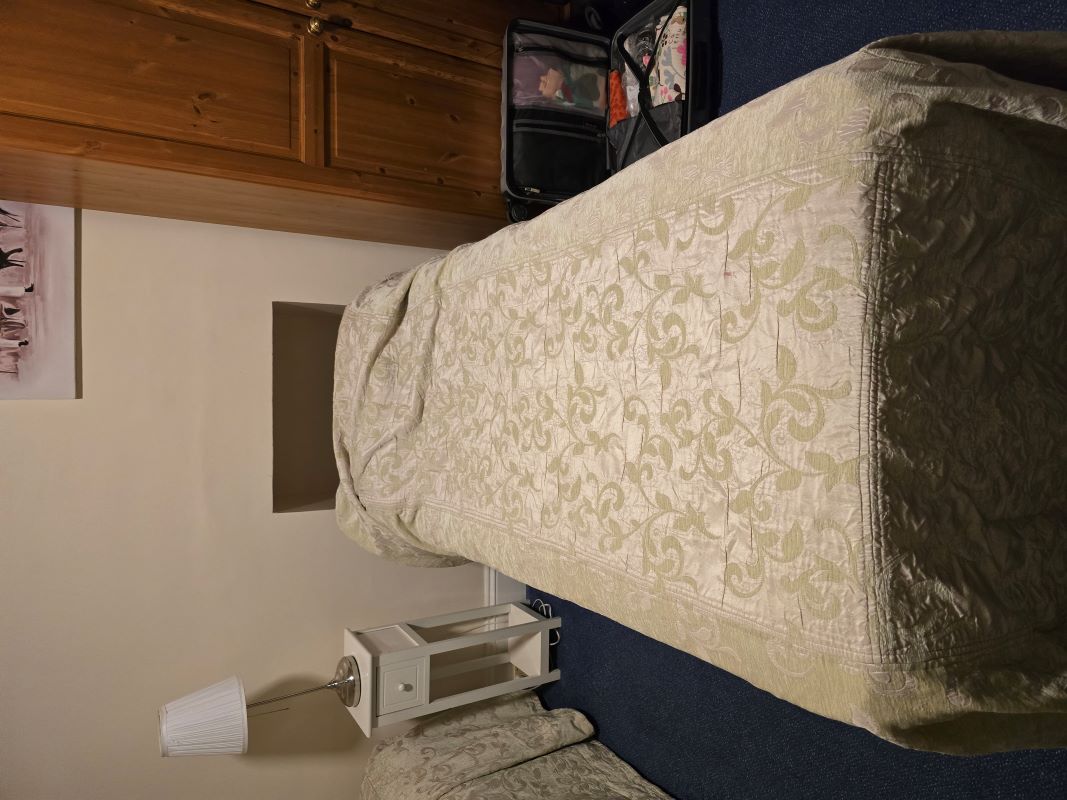
The hotel bed was really narrow. It could give the beds in Tokyo and Jerusalem a run for their money.
Day 1: Kensington Palace and Gardens
The first day was mainly about recovering from jet lag, so we kept the schedule pretty relaxed.
I had expected the jet lag to let me sleep until 10 a.m., but the morning light woke me up much earlier. I’d forgotten to bring an eye mask. Unfortunately, that wasn’t the only thing I’d forgotten: I also left behind our power adapter. Not being able to charge our phones was a serious problem.
After breakfast, I headed to a nearby supermarket. It was Sunday, and the store didn’t open until 11 a.m. Now that’s a relaxed attitude! I ended up buying a USB-A adapter at a smaller convenience store. Then, just to be safe, I asked the hotel receptionist whether they happened to have a power adapter. Turns out they offered them for free…
Oh well. Never mind. The important thing was to get the phones charging ASAP.
After a bit of rest and recovery, we set off for Kensington Palace. Along the way, we spotted some classic London icons: red telephone boxes, double-decker buses, and so on. Naturally, the tourist photos had to be taken.
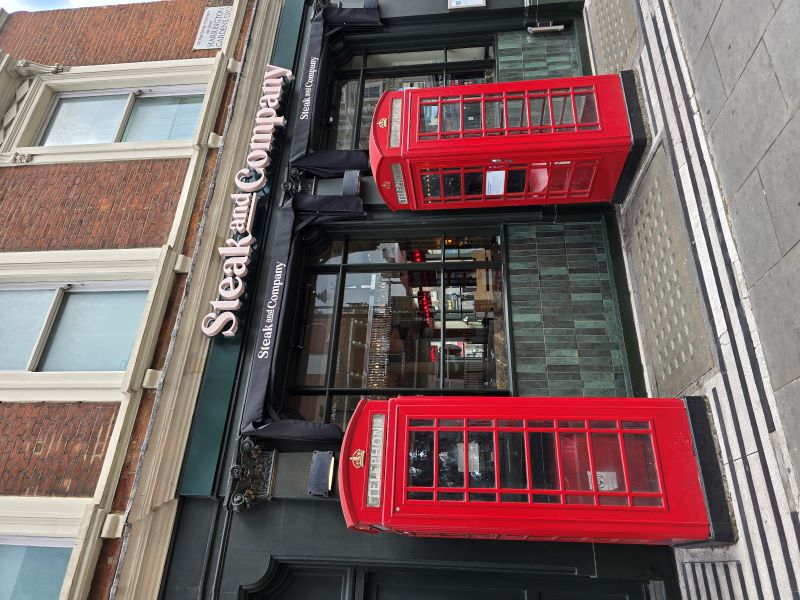
Classic red telephone boxes. There's a notice explaining that they no longer provide telephone services and are now preserved as historical landmarks. The doors are locked, too, so you can't go inside.
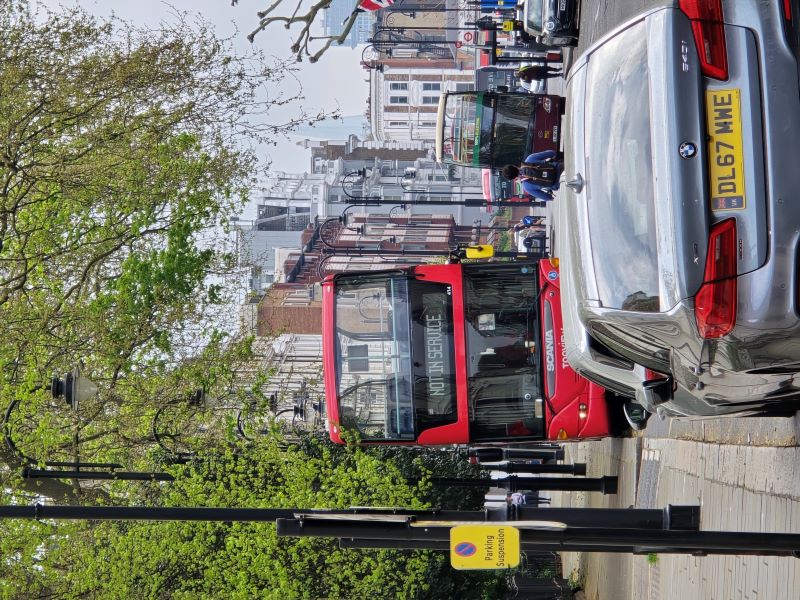
A red double-decker bus.
After visiting Kensington Palace, I picked up a little book called Kids’ Kensington from the gift shop. It covers the palace’s history and gossip, and I highly recommend it. Although it’s in English, it’s written for children, so it’s an easy read.
What follows is based mainly on this book, supplemented by photos from our visit and some discussions with AI. As I wrote this section, I realized I’d ended up covering pretty much the entire history of Britain from the Glorious Revolution onward!
The History of Kensington Palace
After the Glorious Revolution of 1688–1689, William III, Prince of Orange from the Netherlands, became King of England, ruling jointly with his wife, Mary II.
A Brief Detour into Dutch History
In 1555, Charles V, Holy Roman Emperor, abdicated and handed the Low Countries (roughly comprising present-day Netherlands, Belgium, Luxembourg, and northeastern France) over to his son Philip II.
Philip II was also King of Spain, so the Low Countries became part of the Spanish Habsburg Empire. The people of the Low Countries resisted Spanish rule for two main reasons: Protestantism versus Catholicism, and local autonomy versus centralized authority.
In 1568, the Dutch Revolt began, kicking off the Eighty Years’ War (That’s a long time!). William the Silent, Prince of Orange, led the resistance against Spain. He was assassinated in 1584. In 1588, the seven northern provinces formally moved toward a republican system of government. Spain finally recognized the independence of the Dutch Republic in 1648.
A word about Orange:
The Principality of Orange, located in southern France, was established in 1163. In 1544, William I inherited the principality. William III was his descendant, inheriting the title of Prince of Orange and the dynastic claim to the principality.
In 1672, King Louis XIV of France occupied Orange, depriving William III of effective control. The territory was formally ceded to France under the Treaty of Utrecht in 1713.
Interestingly, the place name Orange and the English word for the fruit have different etymological origins. However, because William I led the Dutch resistance against Spain as Prince of Orange, the color orange gradually became an important symbol of both the House of Orange and Dutch national identity.
Members of the House of Orange typically served as Stadtholders of the Dutch Republic and commanders-in-chief of its armed forces. The Orangists and the Republicans became the two enduring political factions of the Dutch Republic.
After the French Revolution, Napoleon established the Batavian Republic. Following Napoleon’s downfall, another William I became King of the United Kingdom of the Netherlands. This is how a country whose political tradition grew out of bourgeois autonomy and republicanism ended up becoming a constitutional monarchy. The southern provinces eventually broke away and became modern-day Belgium.
The Late Stuart Dynasty
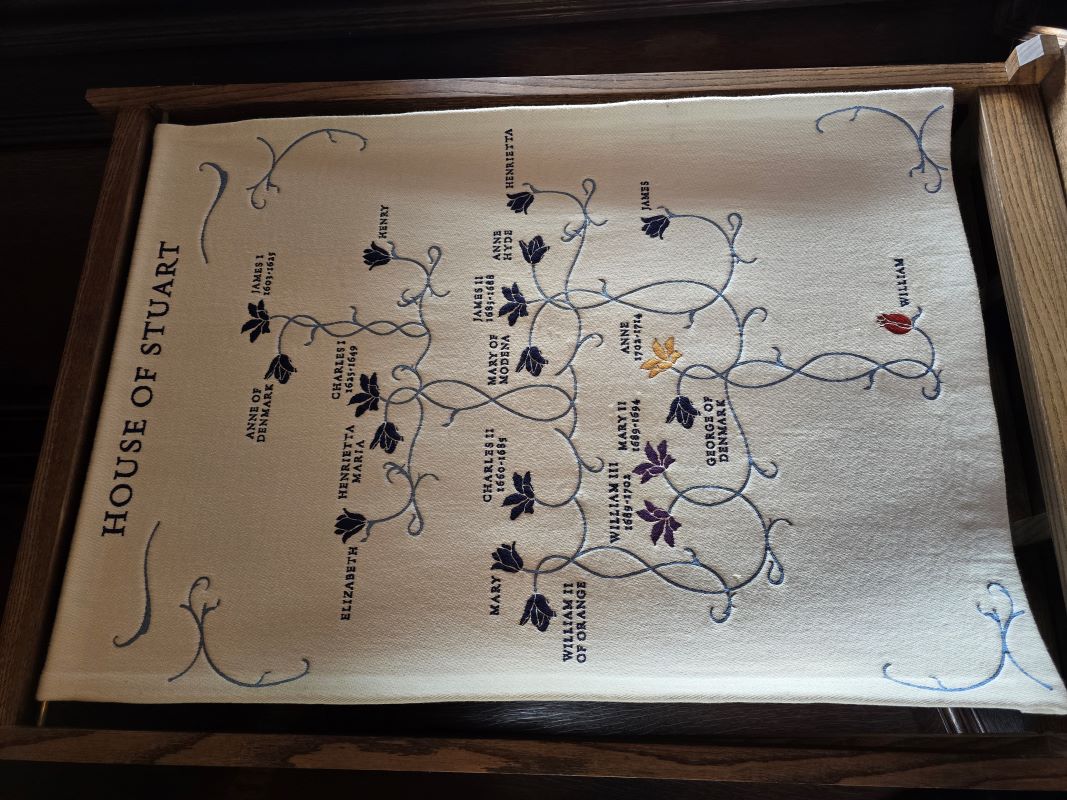
The Stuart dynasty
Back to British history.
Soon after arriving in London, William III fell ill. He found Whitehall Palace, located along the Thames in central London, cold and damp, with poor air and water quality. So he spent £20,000 buying a mansion in the village of Kensington, which he then expanded and renovated into what became Kensington Palace.
William and Mary occupied separate quarters: the King’s Apartments and the Queen’s Apartments.
Five years later, in 1694, Mary contracted smallpox and died at Kensington Palace.
Eight years after that, in 1702, William III was riding near Hampton Court Palace when his horse stumbled over a molehill. He lost his balance and was thrown off, breaking his collarbone. He returned to Kensington Palace, where his health deteriorated rapidly, and eventually died.
William and Mary had no children, so the throne passed to Mary’s younger sister, Anne.
A little royal trivia: William was 1.67 meters tall, while Mary was 1.83 meters!
Queen Anne, who succeeded them, had also contracted smallpox as a child but survived. She lived in the King’s Apartments and put her husband in the Queen’s Apartments. Haha!
Here’s a little terminology lesson: a king’s wife is a Queen Consort, usually shortened to Queen. A reigning female monarch is a Queen Regnant, also shortened to Queen. Her husband is a Prince Consort, not a King. For example, Prince Albert was the husband of Queen Victoria.
Anne commissioned the construction of the Orangery, which served both as a greenhouse and a royal reception and dining hall.
She gave birth 17 times. Only one of her children, Prince William, lived beyond the age of two, but even he died of smallpox at just 11.
In 1714, Anne died at Kensington Palace, bringing the Stuart dynasty to an end. The throne passed to the Protestant House of Hanover.
The Dutch were gone, and now the Germans were taking over. No wonder Thomas Paine criticized the monarchy for not even being British. What’s the point of having a royal family if they’re all foreigners?
The House of Hanover
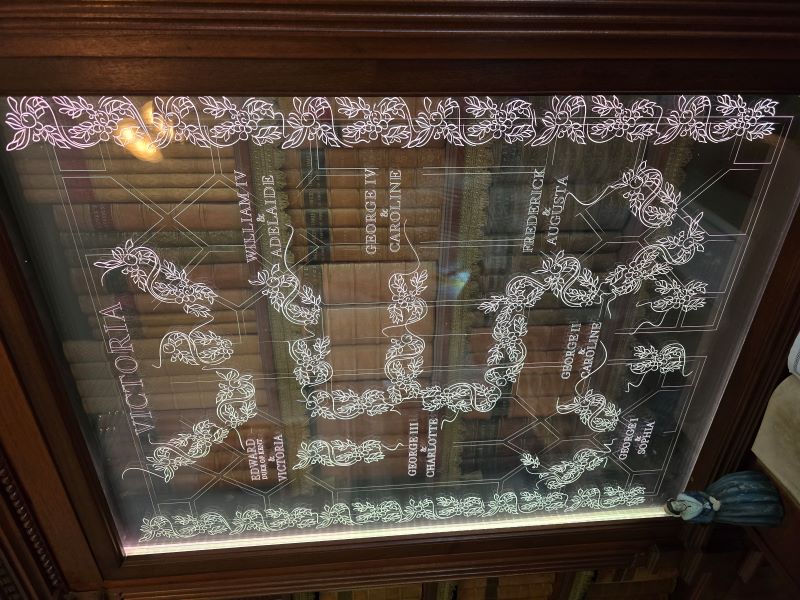
The House of Hanover
George I of the House of Hanover continued renovating and expanding Kensington Palace.
Here’s the dark side of the story: he didn’t bring his wife with him.
George married in 1682, but the marriage was unhappy, being essentially a political arrangement. His wife fell in love with a Swiss nobleman and military officer. In 1694, the officer mysteriously disappeared, and was suspected of having been murdered. In December of that year, George and his wife divorced, after which she was imprisoned in a castle for the remaining 32 years of her life.
Yikes. Couldn’t they just have parted on amicable terms? No need to go that far!
In 1727, George I fell ill while traveling to Hanover and died in Germany.
George II reigned from 1727 to 1760.
His wife, Queen Caroline, was an important patron and participant in the court culture of the early British Enlightenment. Newton, Handel, and Voltaire were all guests at her intellectual salon. Handel also served as a music teacher to George II’s daughters.
A little royal trivia: each princess had five servants, received 192 pairs of new gloves every year, and got a new pair of shoes every week!
George II was not particularly gifted as a military commander, but he was personally brave. He was the last British monarch to lead troops into battle in person. Warfare subsequently became larger in scale and more professionalized, while the monarch’s political and military authority gradually diminished. Later monarchs would visit troops at the front to boost morale instead.
In 1756, George II declared war on France at Kensington Palace, marking the beginning of the Seven Years’ War.
His death was quite dramatic. While he was using the toilet at Kensington Palace, a servant heard a loud crash from inside. When they entered, they found the king lying on the floor, unconscious. Doctors rushed in, but their efforts to revive him were unsuccessful.
George II and Queen Caroline both disliked their eldest son, Frederick. But Frederick died in 1751, so the throne eventually passed to his grandson, George III.
George III reigned for an impressive 60 years, from 1760 to 1820 — putting him in the same league as the Qing emperors Kangxi and Qianlong.
If you’ve been paying attention, you’ll have noticed that the American Revolutionary War took place during his reign.
Another bit of royal gossip: relations between fathers and sons in successive generations of the Hanoverian dynasty were consistently poor. On several occasions, political opponents of the king became rather close to the heir apparent.
Now that’s a palace-intrigue plotline Chinese people are familiar with!
George III preferred living at Windsor Castle, and Kensington Palace gradually faded from the royal spotlight. Toward the end of the 18th century, however, he brought it back into use as a residence for his children and grandchildren. The most famous of them would eventually become Queen Victoria.
Queen Victoria
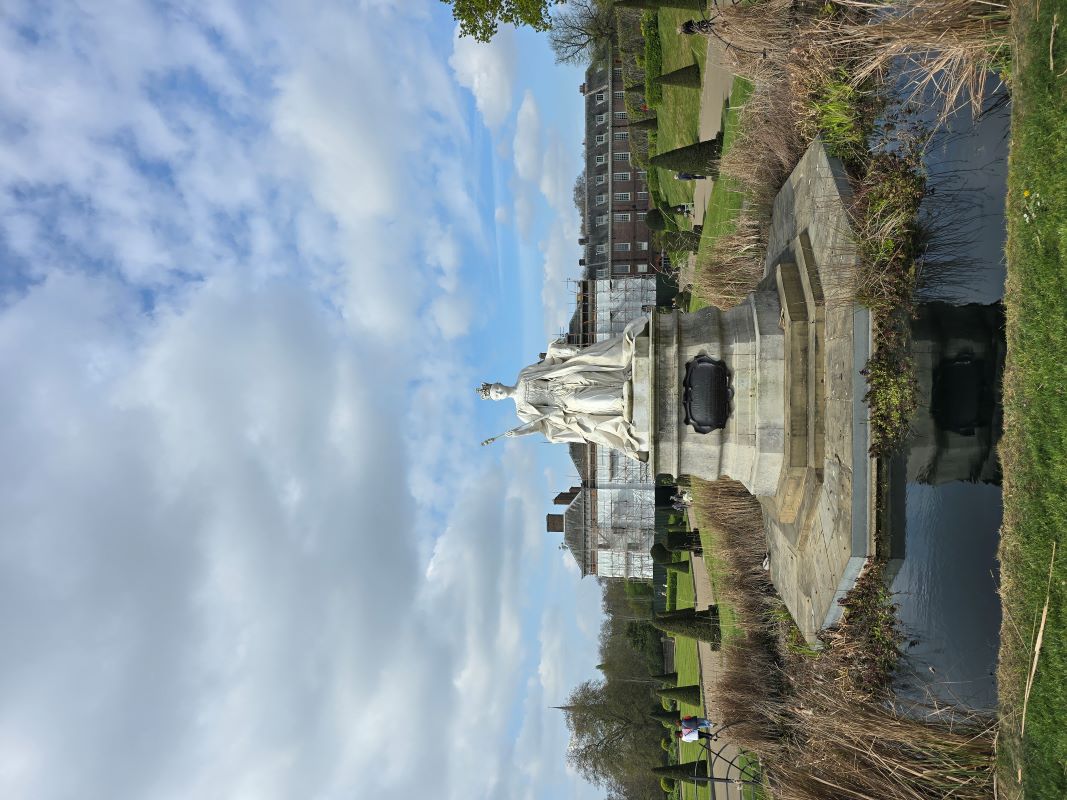
The statue of Queen Victoria outside Kensington Palace. The gardens are in the background, and you can see maintenance work being done on the palace exterior in the distance.
Victoria was born at Kensington Palace and lived there until she was 18.
She grew up under a series of elaborate and restrictive rules imposed by her mother, the Duchess of Kent, and Sir John Conroy. This regime became known as the “Kensington System.”
For example:
- Until the age of 18, she had to sleep in the same room as her mother.
- She was never allowed to walk downstairs without someone holding her hand.
- She was not allowed to make friends with other children. (That was going too far! As compensation, she had 132 dolls…)
- She had to be accompanied by her mother whenever she received visitors.
The system was designed to keep Victoria under control and dependent on her mother and Sir John Conroy.
When she turned 18 and became queen, she dismissed Conroy and distanced herself from her mother. She moved out of Kensington Palace and into Buckingham Palace, which became the monarch’s official London residence.
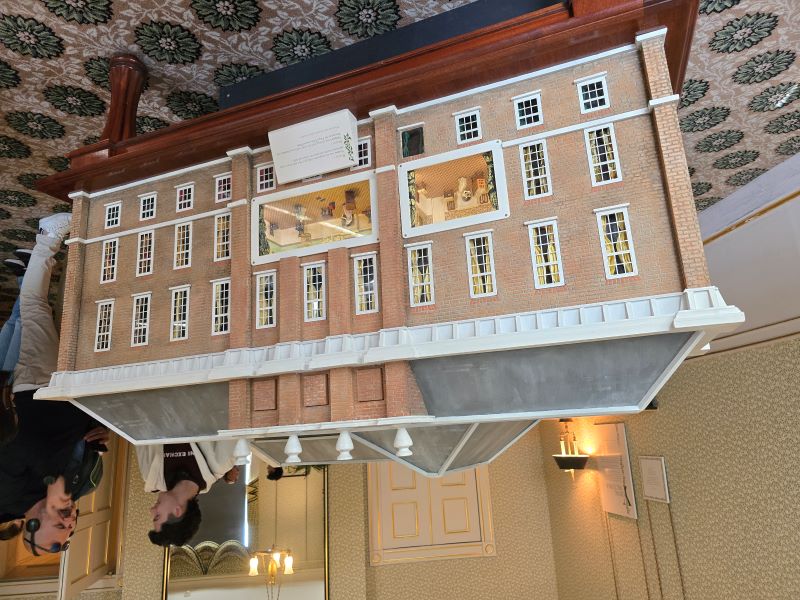
Queen Victoria's childhood dollhouse.
Victoria’s succession to the throne is also worth a closer look.
George III had several older sons, in the following order:
- Prince George (later King George IV)
- Prince Frederick (Duke of York)
- Prince William (later King William IV)
- Prince Edward (Duke of Kent, Victoria’s father)
At the time, Britain followed a system of male-preference primogeniture: sons came before daughters in the line of succession, while sons were ranked by age.
In 1817, Princess Charlotte, the only daughter of Prince George and second in line to the throne, gave birth to a stillborn boy. She herself died from complications following childbirth, aged just 21.
A tragedy similar to Raphael’s mother!
This created a succession crisis. George III’s unmarried sons suddenly became very eager to get married and produce heirs. A royal baby race was on!
In 1818, the Duke of Kent married Princess Victoria of Germany. Their daughter was born in May 1819 — the future Queen Victoria. (Mother and daughter had the same name.)
At birth, Victoria was fifth in line to the throne, behind the four men listed above.
In January 1820, her father, the Duke of Kent, died. Just six days later, her grandfather George III died as well, and her eldest uncle became King George IV.
In 1827, her second uncle, the Duke of York, died without children.
In 1830, her eldest uncle, George IV, died, and her third uncle became King William IV. Victoria was now next in line to the throne.
William IV and his queen had several children, but all died in infancy. They had no surviving adult children who could inherit the throne.
In June 1837, William IV died. Victoria, aged 18 years and 27 days, became queen.
Because she was already an adult, there was no need for her mother to serve as regent.
What a remarkable chain of coincidences!
At the age of 16, Victoria met her cousin Albert at Kensington Palace. After becoming queen, she proposed to him. Naturally, he said yes!
Their wedding cake pioneered the tradition of placing figurines of the bride and groom on the top tier.
Albert came from the German duchy of Saxe-Coburg and Gotha. The name alone hints at a rather complicated history.
Victoria was therefore the last monarch of the House of Hanover. Her son Edward VII succeeded her in 1901, beginning the House of Saxe-Coburg and Gotha.
Queen Victoria broke George III’s record, reigning for 63 years (1837–1901). Her record was later surpassed by Elizabeth II, who reigned for 70 years (1952–2022).
Among the monarchs of major European powers, the only one with a longer reign was probably Louis XIV of France, who ruled for 72 years (1643–1715).
During World War I, Britain and Germany were at war. In 1917, George V decided that having a German-sounding dynasty name was no longer appropriate, and changed the royal house’s name to Windsor.
And that’s the name it still carries today, in 2026.
Modern Times
Kensington Palace was eventually restored and opened to the public. It also served as a museum for a period of time.
During the two World Wars, its gardens were used as military encampments and allotments. During World War II, the palace was hit by Nazi bombing. At the time, the king believed that ordinary people were struggling and that public money should not be spent repairing royal palaces. As a result, repairs were delayed for 30 years.
In more recent times, Princess Margaret, the younger sister of Queen Elizabeth II, lived at Kensington Palace for many years.
Princess Diana also raised her sons, Princes William and Harry, at Kensington Palace.
Since 2011, Prince William and Catherine (Kate) have also used Kensington Palace as their official London residence.
Still, it feels as though modern society has largely lost its fascination with royal life. The mystique is mostly gone.
The Exhibitions
There were four exhibitions: the King’s State Apartments, the Queen’s State Apartments, Queen Victoria’s childhood, and an exhibition of royal fashion.
I’m not particularly interested in old palaces and antique furniture, but the staff were genuinely enthusiastic and attentive. Seeing that we were pushing a stroller, they went out of their way to help us through various hidden passageways, minimizing the number of times we had to use the elevators.
Much appreciated!
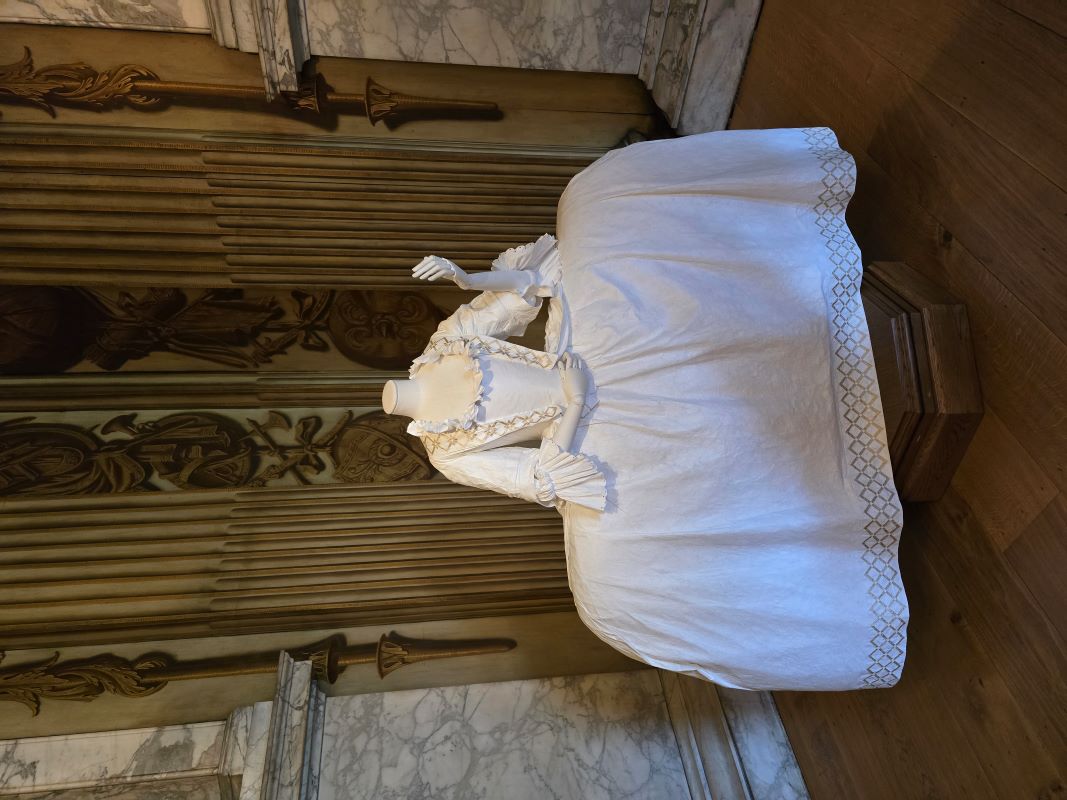
The skirts of the time were made so incredibly wide. They must have been terribly inconvenient to wear.
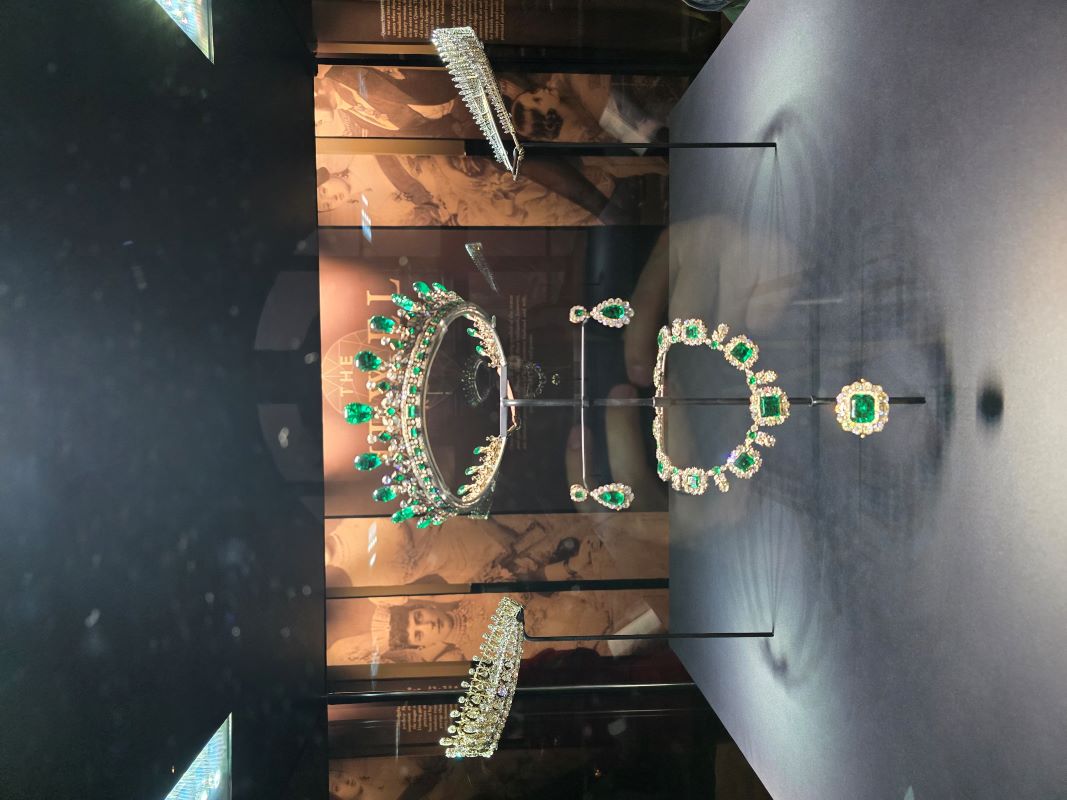
A matching emerald parure — tiara, earrings, necklace, and brooch — designed by Prince Albert for Queen Victoria.
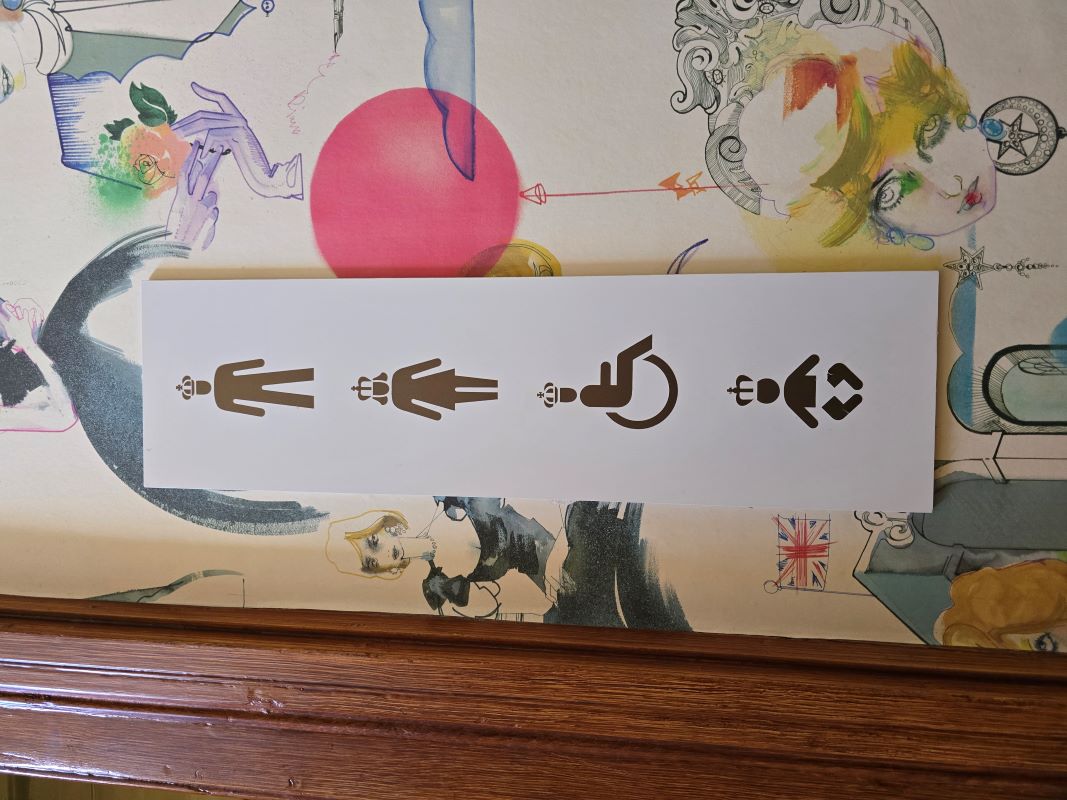
The restroom signs. Everyone gets to wear a crown here, haha!
Afternoon Tea at the Orangery and a Walk in the Gardens
After a casual stroll through the gardens, we headed to the Orangery for afternoon tea.
I couldn’t quite make sense of the menu. All I could see were the labels “top tier,” “middle tier,” and “lower tier,” followed by several lines of text.
I thought, how refreshingly transparent! Just like Tian Ji’s horse-racing strategy, they’re clearly labeling the upper-, middle-, and lower-grade teas for you!
But when the food arrived, it turned out that these weren’t different grades of tea at all. They were tiers of a rather fancy little serving stand, with three plates stacked vertically, each holding an assortment of small treats.
Everything was quite delicious.
It got me thinking: why don’t we present Chinese braised snacks this way? The top, middle, and bottom tiers could each hold different body parts: pig ears, beef tripe, and chicken feet. That way, the anatomical hierarchy would correspond perfectly to the physical arrangement. What a brilliant idea!
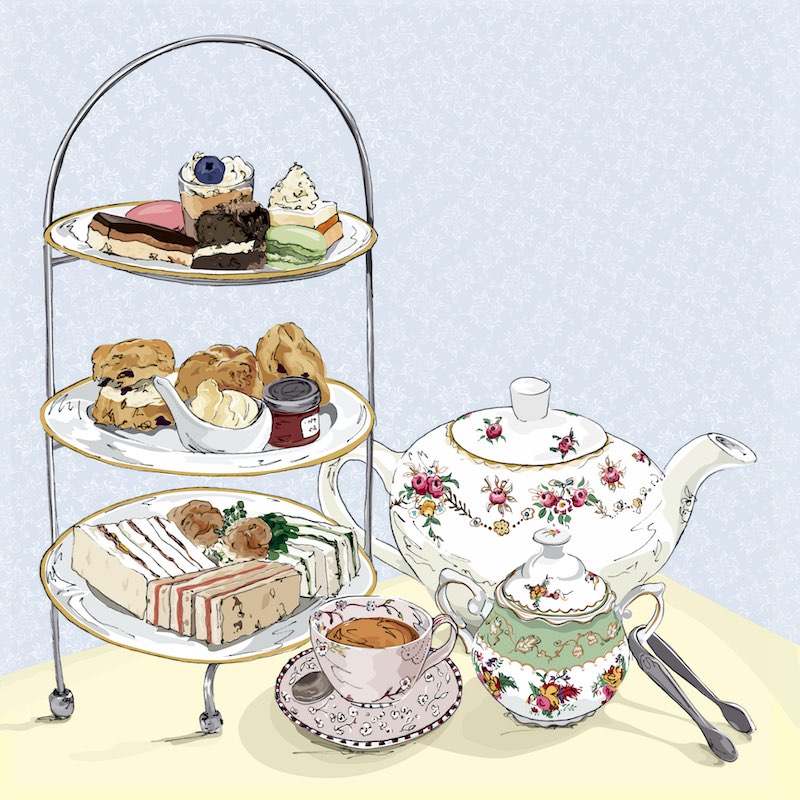
Afternoon tea (image from the internet).
After eating, we went for a walk in Kensington Gardens to burn off some calories.
There were lots of people feeding the birds by the pond. Even those supposedly noble swans weren’t particularly graceful when competing for food.
Epilogue
We walked a little farther north to the Diana Memorial Playground. It has an interesting rule: adults are only allowed to enter when accompanied by a child.
Talk about turning the tables!
After the playground, we headed back. Then I suddenly remembered the Easter egg hunt, so we collected two nearby eggs along the way.
We also made a few sightseeing stops at the Royal Albert Hall, the Royal College of Music, and Imperial College London.
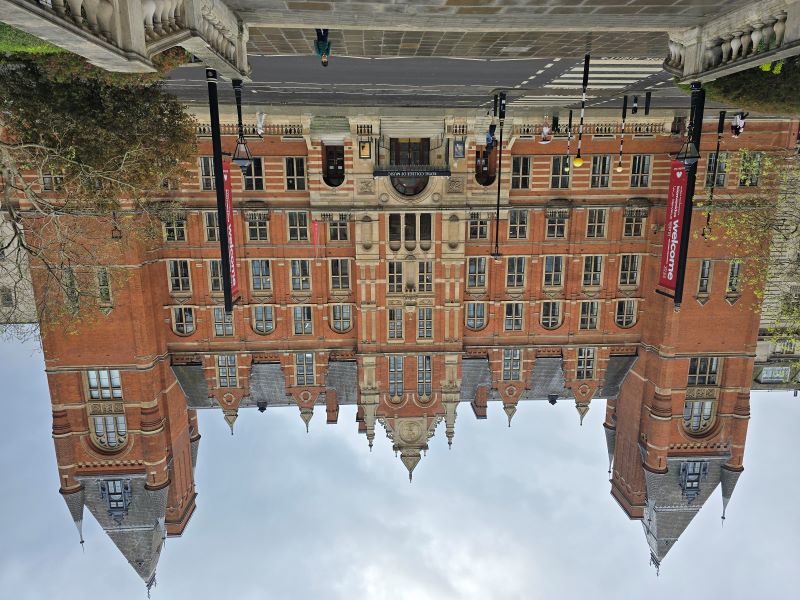
The Royal College of Music. What an impressive building!
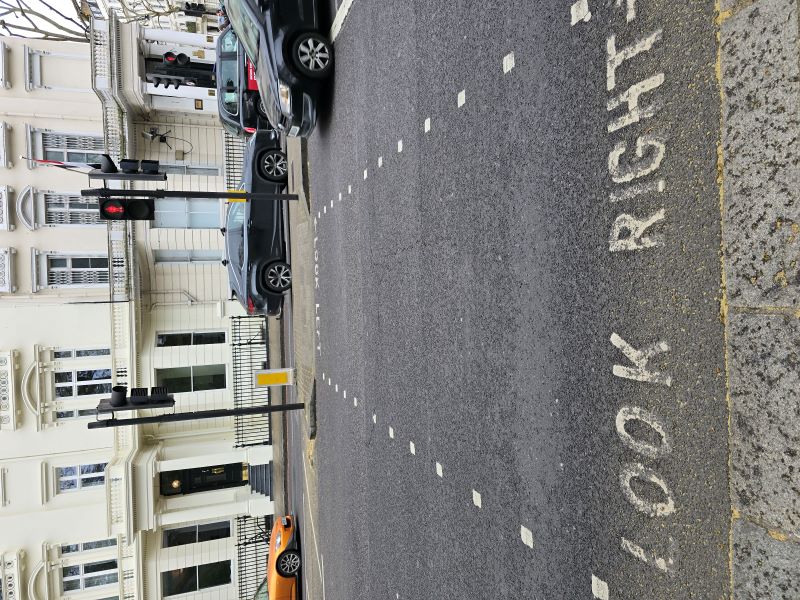
In Britain, traffic drives on the left. Since foreign visitors might not be used to this, the words LOOK RIGHT and LOOK LEFT are painted on the road to remind pedestrians which direction to watch for traffic.
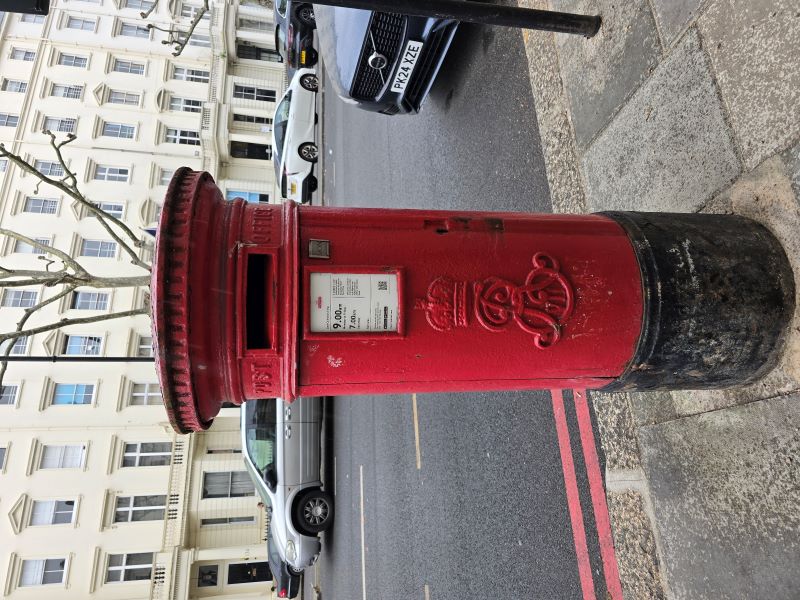
A conspicuous red postbox.
We had Chinese food for dinner, called it a day, and got some rest.
More adventures tomorrow!