 David Feng
GEB Reading Notes #1: The Chinese Edition’s Preface and Introduction
(Translated from the Chinese version with the help of ChatGPT.)
How It All Began
Last weekend, I dropped my son off at a classmate’s birthday party. As expected, the kids had a blast, running around until they were sweaty and exhausted. What I didn’t expect was to have such a stimulating conversation with another parent. We talked about AI, work, philosophy, the self, and so on.
At one point, I asked him, “Have you read GEB?”
He said, “I have. But I don’t think I understood it as deeply back then as I do after our conversation today.”
Me: 🥹
A week later, we decided to reread this strange and wonderful book together, one chapter per week, like a book club. So I thought I’d open-source my reading notes here. Why enjoy something alone when we can enjoy it together?
The book covers a wide range of topics: mathematics, intelligence, isomorphism, self-reference, and more. Here’s a nice introduction. But don’t let the subject matter intimidate you. Some parts are difficult, others are quite accessible, and the whole thing is a lot of fun. The original was published in 1979. Now, in 2026, with LLMs advancing at breakneck speed, the Chinese Room has become a reality. Which of the book’s theories have become obsolete? Which still hold up?
The author, Douglas Hofstadter, is the son of Robert Hofstadter, who won the 1961 Nobel Prize in Physics. Hofstadter’s Law comes from Chapter 5 of this book, “Recursive Structures”: It always takes longer than you expect, even when you take into account Hofstadter’s Law. Another self-referential joke.
So let’s give this a shot and put our money where our mouths are. The book has twenty chapters. At one chapter a week, that’s twenty weeks. Add the preface, introduction, and various holidays, and let’s call it twenty-six weeks, or half a year. Starting in early October, can we make it to the finish line by the end of March 2027? Let’s find out.
Here are some related resources worth checking out:
- MIT GEB Lectures I watched one or two of these videos years ago and found them a little superficial. Each video generally covers several chapters. I’ll probably refer to them during this reread, too.
- MIT GEB Lots of supplementary material. The most interesting feature is that each chapter is paired with a piece by Bach.
And a quick shout-out to yihong哥 for his 2022 post. If a thought keeps coming back to you, eventually the time will be right. No time like the present—let’s get started!
分享下我的床头书 -> 最近几个月睡前会看看的书。
— yihong0618 (@yihong0618) August 27, 2022
btw, 《沙丘》和《哥德尔埃舍尔巴赫》是用来催眠的,睡不着才回去翻,因为读了好多次开头都没读进去。 pic.twitter.com/V69TuDCuGx
The Cover
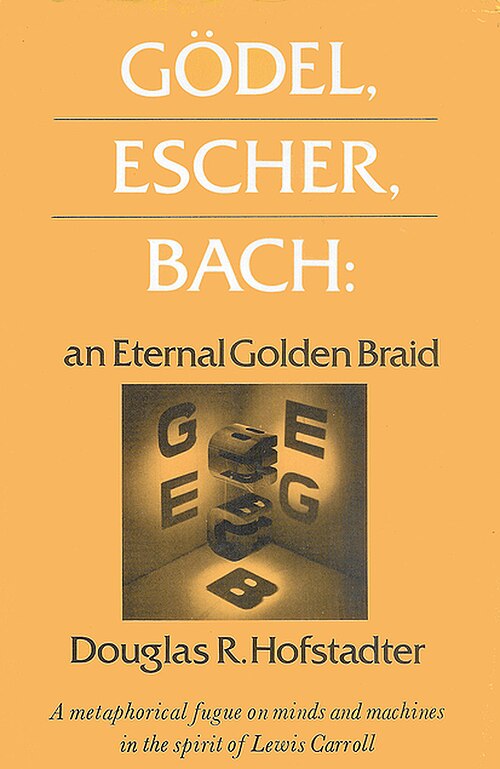
Original English edition
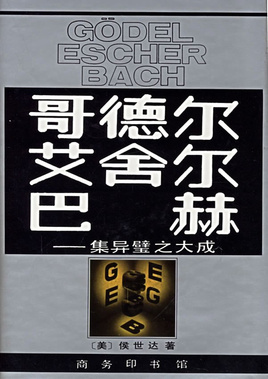
Chinese edition
(That’s how hardcore these reading notes are: we’re starting with the cover.)
When my fellow reader sent me the original English cover, I noticed for the first time that it had a line at the bottom that was completely omitted from the Chinese edition:
A metaphorical fugue on minds and machines in the spirit of Lewis Carroll
If this counts as a subtitle, then perhaps An Eternal Golden Braid should be considered part of the main title?
The line also gives us a clue about the book’s central themes: minds, machines, and the intersection of the two—that is, artificial intelligence.
Lewis Carroll, of course, is the celebrated author of Alice’s Adventures in Wonderland. ChatGPT tells me that his other relevant works include Through the Looking-Glass, where “Jabberwocky” makes its appearance. In fact, the second dialogue in GEB, “A Two-Part Invention,” reproduces Carroll’s “What the Tortoise Said to Achilles” in its entirety. Hofstadter is definitely a Carroll superfan.
With its wordplay and its explorations of logic, GEB makes Hofstadter something of Carroll’s intellectual heir.
As for the fugue, it is a musical form in which a theme is repeatedly introduced, transformed, and interwoven with itself. It’s a bit like several strands of hair woven together into a braid. And Bach, of course, is the undisputed master of the fugue.
The Chinese Edition’s Preface
Hofstadter begins by expressing his longstanding fascination with and special affection for Chinese language and culture.
He married his first wife, Carol Ann Brush, in 1985, and they had two children. But she died in 1993, when the children were still very young. Hofstadter discusses this period in I Am a Strange Loop.
He met his second wife, Baofen Lin, in 2010, and they married in 2012. Judging by her name, his second wife is probably of Chinese descent. (Why is it that even when discussing serious literature, I can’t resist a little gossip?)
In 1981, Hofstadter wrote annotations for the translators of GEB, explaining the book’s wordplay, including acrostics, palindromes, and puns. Unfortunately, this official guide doesn’t seem to be publicly available.
Hofstadter argues that a translation faithful to the spirit of the book should reproduce similar linguistic games in the target language—or, to borrow the book’s own terminology, create an isomorphism between the original and the translation. One example would be translating English flat Coke into a Sichuan dish that has lost its spiciness: the literal meanings differ, but the underlying joke is preserved through an analogous expression in the other language.
Hofstadter strongly rejected the first draft of the Chinese translation, which relied primarily on literal translation and used translator’s notes to explain the wordplay. He believed that works like GEB, which are largely independent of any particular culture and are mostly nonfiction, should be translated through this kind of transposition rather than literal rendering. Fiction, by contrast, could generally be translated using more conventional methods. (Of course, many plays have also been adapted to different cultural contexts, sometimes with unexpected results.)
This reminds me that after finishing the Chinese edition, I could read the corresponding passages in English, if I’m interested, and see how the transposition actually works. Our reading notes could even become a kind of reverse engineering of Hofstadter’s official guide.
People usually recommend reading books in their original language. Well, in this case, reading both the translation and the original gives us twice the fun! Many thanks to the translators of the second Chinese edition for all their hard work.
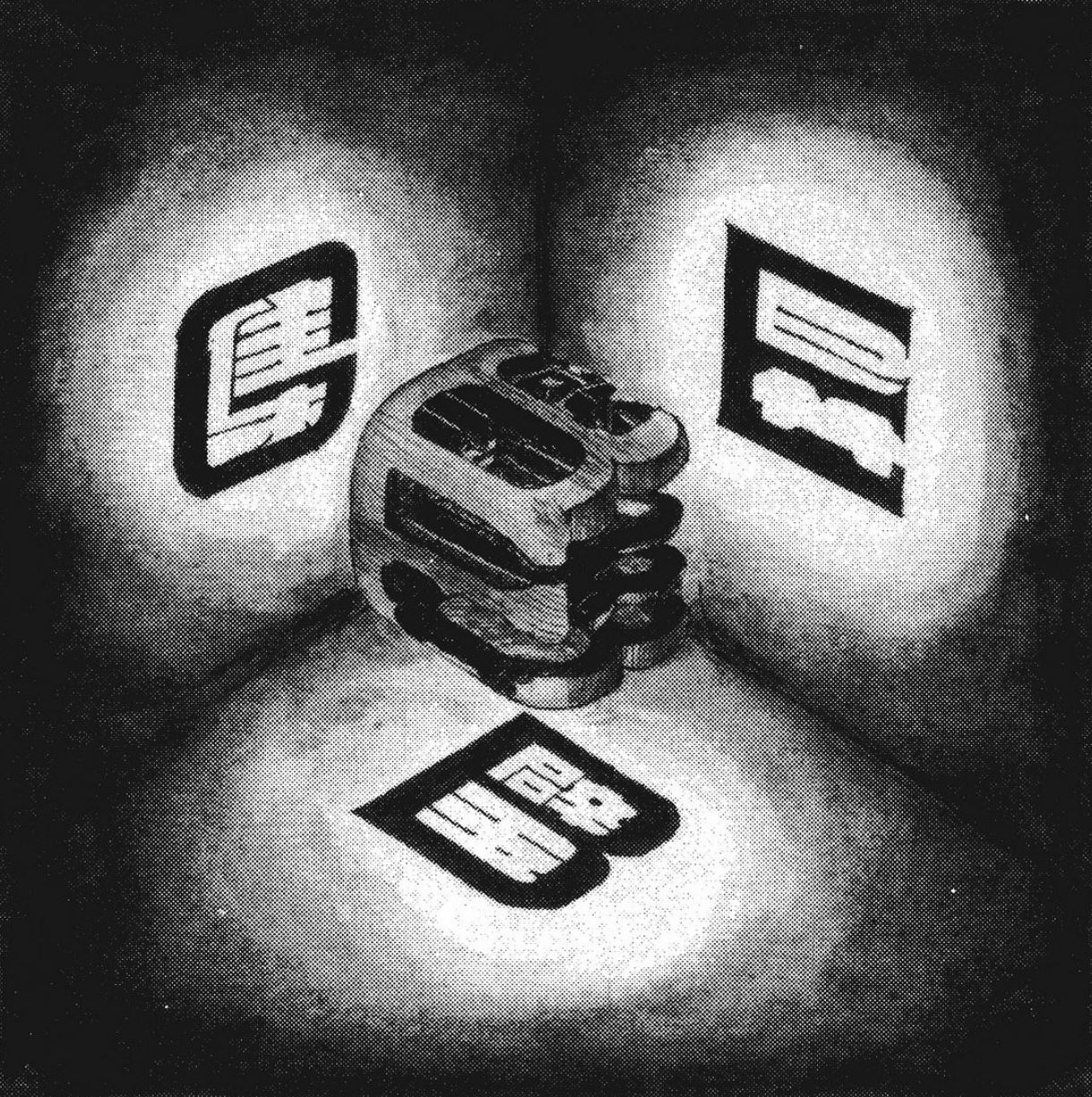
The three Chinese characters in the Chinese edition of GEB 集异壁, hand-drawn by Liu Haoming, one of the translators of the second edition
Further Reading
A list of related materials to read when I get around to it:
- Lewis Carroll, Alice’s Adventures in Wonderland
- Lewis Carroll, Through the Looking-Glass
- Douglas Hofstadter, Le Ton beau de Marot, on the translation of GEB
- David Moser (a friend of the author and one of the translators of the second Chinese edition), Sze-chuan Pepper and Coca-Cola: The Translation of Gödel, Escher, Bach into Chinese
The Introduction
Following the music recommendations, we’re pairing this reading with Bach’s Brandenburg Concerto No. 5 (BWV 1050). No particular reason—it just sounds great, haha.
-
The very first line of the main text is “Author:”, which means we’re already dealing with self-reference.
-
Let’s start with Bach.
-
Frederick the Great (Frederick II) was born in 1712 and ruled Prussia from 1740 to 1786. Bach was born in 1685 and died in 1750. When the two met in 1747, Bach was 62 and would die three years later; Frederick was 35.
-
Bach composed canons. Here are several different types:
- The imitation reproduces the same theme, offset in time. This is the familiar round. The Chinese edition gives “Defend the Yellow River” (Baowei Huanghe) as an example, while the English original lists children’s songs such as “Three Blind Mice,” “Row, Row, Row Your Boat,” and “Frère Jacques” (“Two Tigers” in Chinese!). Caught you, transposition!
- The imitation reproduces the theme at a different pitch.
- The imitation moves at twice or half the speed of the original theme.
- The imitation moves in the opposite direction: when the original melody goes up, the imitation goes down. This is inversion.
- The imitation plays the theme backward, from end to beginning. This is retrograde, also known as a crab canon.
- Whatever the transformation, the imitation preserves all the information in the original theme, allowing us to reconstruct it. This kind of information-preserving transformation is called an isomorphism.
- In chemistry, isomorphism refers to different substances having similar crystal structures. Examples include silicon carbide (SiC) and diamond, and potassium chloride (KCl) and sodium chloride (NaCl).
- Remember the four types of “same-ness” from high school chemistry? Isotopes (hydrogen and deuterium), allotropes (oxygen and ozone), homologues (methane and ethane), and isomers (ethanol and dimethyl ether).
-
An endlessly ascending canon is the first example of a strange loop in the book.
-
A strange loop, or tangled hierarchy, occurs when moving up or down through the levels of a hierarchical system unexpectedly brings us back to where we started. Hofstadter’s 2007 book I Am a Strange Loop is somewhat like an abridged version of GEB. MIT’s ES 258 course considers it too repetitive of GEB to recommend as a supplementary resource. (See related resources.)
-
-
Now, Escher.
Visual examples of strange loops include Waterfall (1961), Drawing Hands (1948, a two-step strange loop), and Print Gallery (1956, a one-step strange loop).
-
Then, Gödel.
The discussion moves on to the liar paradox and Gödel’s incompleteness theorems.
- Gödel’s stroke of genius was to use numbers to represent statements. This makes it possible for a statement in number theory to be about another statement in number theory—even about itself.
- Gödel sentence G: “This statement in number theory is unprovable within the system of Principia Mathematica.”
- It is true, but unprovable. This shows that the system of Principia Mathematica is incomplete: there are true statements that the system is too weak to prove. The set of provable statements is a proper subset of the set of true statements.
- A brief history of mathematical logic: the attempt to mechanize reasoning. Hofstadter mentions Lewis Carroll’s puzzles. I asked ChatGPT about them, and they seem to belong to the same intellectual lineage as Raymond Smullyan’s work.
- Russell’s paradox: Some sets are “ordinary”—they are not members of themselves. The set of walruses is one example. Other sets are “self-swallowing”—they are members of themselves. The set of all sets is an example. The paradox: Is the set of all ordinary sets ordinary or self-swallowing?
- Grelling’s paradox: Some adjectives are “autological,” or self-descriptive, such as “polysyllabic.” Others are “heterological,” or non-self-descriptive, such as “incomplete.” The paradox: Is “heterological” itself heterological?
- The common culprit behind these paradoxes is self-reference. The solution adopted in Principia Mathematica is type theory, which prohibits self-reference. Hofstadter strongly criticizes this approach. Ordinary concepts such as “I” and “this book” would become forbidden, not to mention discussions of type theory itself. The goals of Principia Mathematica were consistency and completeness.
- Pioneers of computing: Charles Babbage said that if he could return to the world five hundred years later for a three-day guided tour of scientific discoveries, he would gladly give up the rest of his life in exchange. He died in 1871, just 155 years ago as of 2026. As the Chinese saying goes, “If I hear the Way in the morning, I can die content in the evening!” Ada Lovelace and Alan Turing follow. Hofstadter argues that strange loops involving rules that directly or indirectly modify themselves are central to intelligence.
-
Finally, back to Bach.
The discussion returns to Bach and Frederick the Great’s court philosopher, La Mettrie, author of Man a Machine.
-
An overview of the book’s structure.
Each chapter begins with a short dialogue that introduces the concepts to be explored in that chapter.
To be continued… See you next week for Chapter 1!